GLEN KRISTI
COORDINATED SEPARATES : Kristi's essays & matching VIDEOs
Selected Essays

Glen Kristi’s journey began in a modest factory town in New Jersey, where the threads of tradition and ambition first intertwined. Her essays appear in two locations on this site, both under "Her Essays" and "Family History."
The difference being that the family essays focus on her upbringing, while the others address experiences from art school to the end of her life.
This section of her retrospective explores the origins of her vision. Hers is a legacy built on the quiet strength of her family and the vibrant culture that shaped her early years.
Kristi's Grandparents: John Polowniak (b. 1884), and Marianna (Mary Kasica) Polowniak (b. 1881), who immigrated to Passaic, NJ from Poland. She was older than he, and a Whispering Witch.
The Women
A Family Legacy of Poland's Whispering Witches

There was a huge old trunk that just about fit into a room off the porch upstairs where she stored important stuff It was the trunk she came over with from Poland when she was a teen.
When the trunk was opened there was a kind of shelf about 3 inches high that could be removed to reveal the bottom of the trunk. She removed this shelf and placed her stash in the corner at the bottom of the trunk, replaced the shelf and closed the trunk.
I started calling all my closest relatives to see if anyone else related to this story, but no one ever knew or heard about it. My sister, 13 years my junior, was the only one to have this same experience.
After a lot of research on the Net, I found Sweet Grass, which was used by the Roma gypsies and the American Indians to heal and bring good spirits.
Though sold in a braid, still doesn't look the same as what I remember, unless they put it through a different process in Europe. Flax was used for folk remedies to treat a list of illness.
It was dusk. A candle's golden glow revealed an empty kitchen table cleared of all signs of dinner, a dinner which I had missed since I was in bed with the "croupe".
Grandma's silver hair was pulled back in her usual braided bun as she was carefully, thoughtfully positioning the candle and a box of wooden matches on the table. She slowly opened a colorful bandana tied in a hobo's knot My grandmother Babczie (Bob -chee) came to this country all by herself from Poland at age 13.
There were all kinds of other country remedies like hot milk and honey , mustard plasters, rock sugar candies on a swizzle stick, but this one was the most bizarre and to me, a seven year old, just a bit daunting, when the bandana was unknotted, there was a small packet wrapped in another white handkerchief inside that revealed a corn silk-like braid.
Babczie worked diligently pulling just enough fibers from the braid and rolled them in both hands until she formed a gossamer ball, then created two more and lined them up on the table. Grandma had covered my shoulders with a towel and used another one on my chest.
Babczie chanted and then set fire to one of the gossamer balls. I could see the fireball through the cloth over my face; it was moving from left to right across my face a few times and then was let go toward the ceiling to disintegrate. I could feel the heat. There didn't seem to be any burnt odor at all.
This went on three times, all the time there was whispered chanting. The hood and towels were removed, and the "cure" was done!
There was no evidence of fire or smoke, and grandma carefully put away all her wares back into the treasured bandana as if she wouldn't be able to get any more, to be used for the next occasion of croupe, boil, headache, infection, etc.

Curator's Note: After her death, Kristi's unpublished manuscript for her autobiography was found by her daughter who then scanned, edited and verified her accounts through both public and private sources.The selected chapters/essays that are included on this website were intended to be part of her autobiography "Blueberries in My Bedroom," which she began in 2007. Because the work is incomplete and rages over so many topics, we have chosen to curate those recollections - from fashion to celebrities and family - as a means of enriching the historical, cultural and fashion insights in multiple sections to enrich the experience of seeing the time frame spanning her early life, family, Parsons School of Design circa 1948-1951 and her 15 years living in New York. This section helps us realize just how far she had to travel culturally, in order to achieve her vision.
The hole in my heart grew larger this year of 2012. It was a difficult year in so many ways. So, as I reflected on an old tune, I started to orchestrate old memories of Christmas.
“Whenever you're feeling sad, just hold your head up high, and whistle a happy tune, and think of happier times." (Whistle a Happy Tune from The King and I).
So, I went back into that two-story house in the ethnic neighborhood in Passaic, NJ, where my family gathered each year on Christmas Eve.
By this time, all my aunts and uncles were married and some had children Uncle Peter had married Aunt Agnes, Uncle Emil met Lola in Missouri and they brought little Brian, Aunt Stella and Uncle Charlie had Alice and Ted in tow. Aunt Kate and Uncle John brought Andy. Aunt Jo had four children, Mary, Jeanette, Tommy and Billie. And of course, my sister Fran was already here, she was almost the same age as Andy.
She arrived late in my mom's life, and that was one of the happiest days of my life! I finally a sibling!
Despite being married, and now parents, my aunts and uncles were not at all subdued. The teasing never stopped now that spouses had joined in.
Uncle Charlie had so many jokes I cannot remember them all, but now, my children and Alice and Ted help me remember so that the laughter still goes on today.
Babczie got a bit older ,but her cooking seemed more aromatic, as if that were even possible ! The fare at Christmas still had Pierogi , but there was a lot of soup e Once we all sat down, the first dish was a mushroom soup with poignant dried mushrooms (much more flavor!) floating in the thick golden brown liquid.
The second bowl was a massively thick cabbage soup like only my grandmother knew how to do flavored with fat back. Third and fourth were two kinds of Boschz one was red and one white.
The red was made with freshly cooked beets, the white was milk white. My Mom could never get the white one (Zurek) right, it curdled every time and frustrated her beyond any consoling. Then we watched grandma demonstrate how to eat the "Zurek."
First she sliced a boiled egg or two into the hot liquid, then sliced some kielbasa, and the "piece de resistance." She broke off large chunks of the hot seeded rye bread and tossed them into the plate It was only then was it ready to enjoy .
Each time a course was announced there was a chorus of groans from the children.
They weren't hungry for food, I'm not sure the children ate very much, they just wanted to open their gifts. Maybe they were tempted to eat the pierogies covered in butter, not sour cream. My favorite were the ones stuffed with plums! The others were filled with potatoes and cheese , sauerkraut, or just cheeses.
The next time the table was cleared it was time for desserts !The entire table and it was along snake like table, was covered with grandma's Chrushczicki and my Mom's Kolach. These were long loaves filled with Poppy Seeds ,Nuts, Cheeses, and Lekvar, then sliced and sprinkled with powdered sugar to match the "Chrusty."
Then there were myriads of cookies Mom and Aunt Kate made .Not to be outdone ,everyone also made Christmas cookies ,that I cannot even recount, there were so many Finally, the announcement for the finale all the children were waiting for brought pie of joy ! ! ! ! ! !
Fine tuning the opening of the presents, was another matter, calling off the tags and handing them to each anxious child, the sound of shredding paper, the yelps ,the laughter, the chorus of happy, grateful children all in one room with adults who refuse to grow up was unmatched by any other experience.
The sound of all the voices, catching up with each other, teasing, laughing, enjoying each other and all the time sampling the delicious food.
Christmas in Passaic


CURATOR'S NOTE:
"Christmas Eve Gathering" was written by the designer in 2012 when her son, Adam Goldenthal, was suffering from bipolar illness.
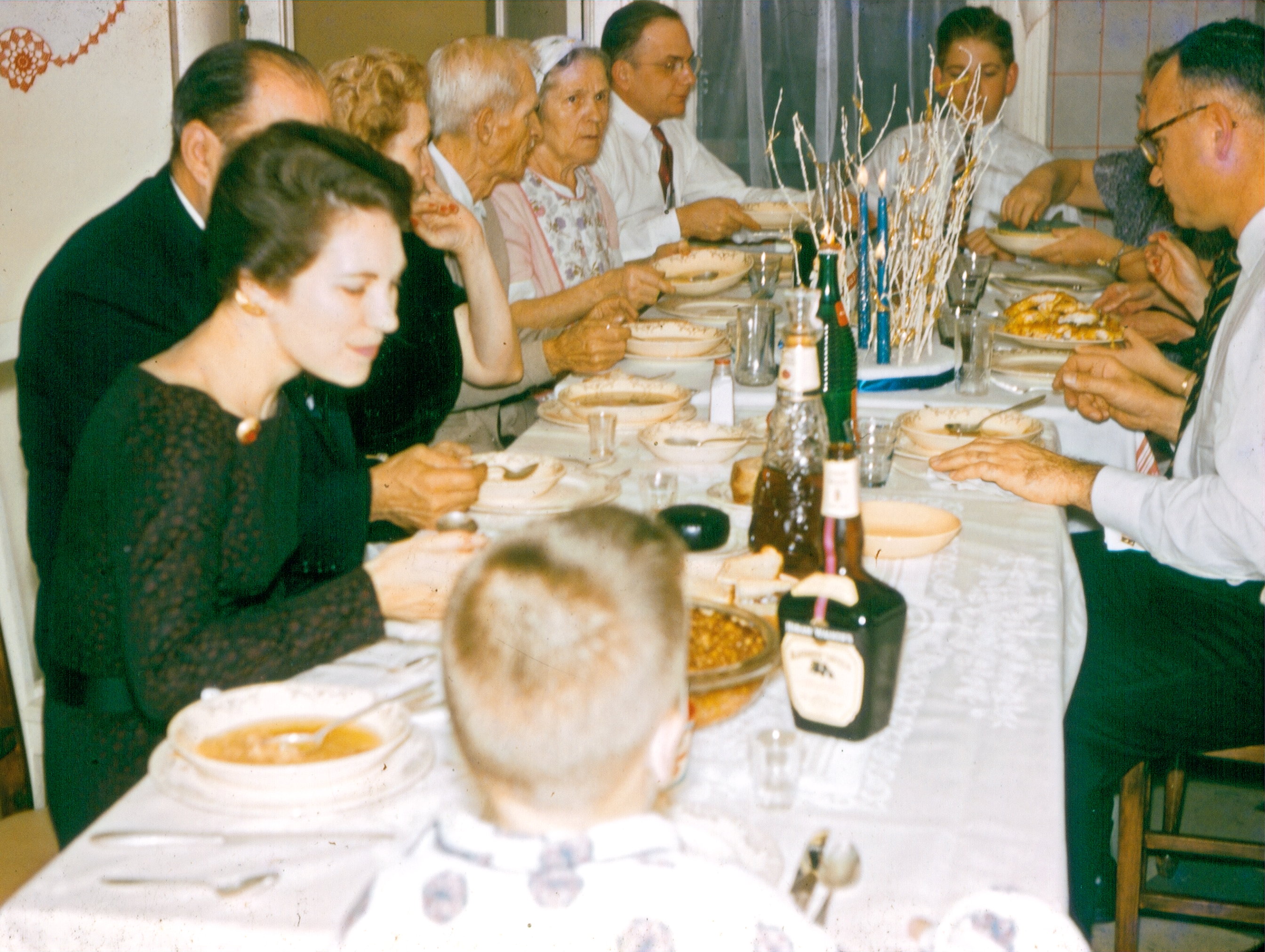
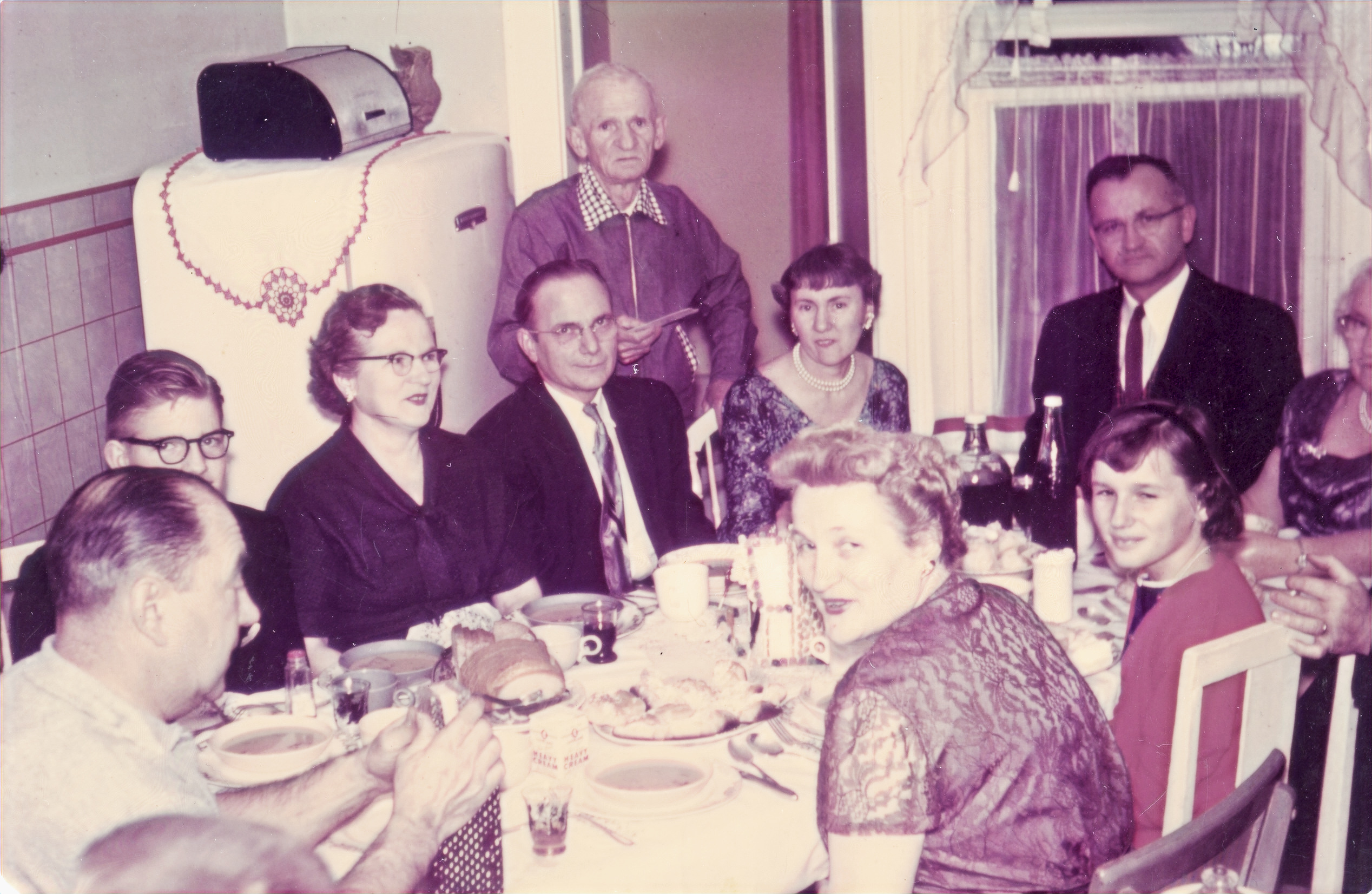
The Image above was taken during Wigilia (Christmas Eve Supper), Passaic, NJ circa 1957. From Left: The partially bald man with the dark hair and glasses is Charles Sectish (Alice and Ted's Father). The lady seated next to him in the blue dress is Mrs. Lane (Peter Polowniak's Mother-in-law). The next lady is Kristi's Mother, Anna Kapinos. Back: The next man in the background with the dark suit and glasses is Kristi's Uncle, Peter Polowniak. The lady in the front with the dark hair and light dress is Stella Sectish (Alice and Ted's Mother). The lady in the background with dark hair and dark blue dress is Agnes Polowniak (Uncle Peter's Wife). The young man in the front with the blue jacket and red tie is Ted Sectish. The man in the background with the blue tie and glasses is John Gorun. The lady next to him with the dark hair and glasses Is Katherine (Polowniak) Gorun. The elderly man in the fore ground is John Polowniak (Dziadek). He is handing the oplatek (Catholic Host/Wafer) to Kristi's Mother, Anna.
It was a small narrow two-story house on a dead-end street My grandparents lived upstairs with my aunts and uncles. My mom and dad and (later my sister) lived downstairs.
It would be good to know that this day began at 4 A.M. I was four years old. This being the first gathering of its kind that I remember. It was like peeking through a hole in the fence. All I could see was ink black and maybe a little haze.
My Mom was trying to wake me. It was eastYe and I had to be at church to be in an Easter procession at 5 A.M. Since I was in a complete fuzz, mom proceeded to dress me.
First there were the thick, long, white stockings, the impeccably white high tied shoes, next a full slip and an embroidered white organdy dress that my mom had made from scratch and a 4b wide sash to hold it all together.
The crowning glory was to be my hair. I had thick naturally curly stubborn hair that frizzed at any slight sign of dampness.
My mom sat me on the kitchen table, all too high and got out the dreaded instrument from hell, the curling iron!
She was about to create my Kielbasa curls, which to anyone outside this neighborhood were known as Shirley Temple curls. As my mom worked, my head nodded (I was half asleep) l woke abruptly to the pain and my own bloodcurdling scream because my mother had burned my ear again Since the excruciating pain (to me) ever kept me awake, the process was repeated again and again.
Simultaneously we heard a large crash above us, in my grandma’s kitchen. She was caught off guard and dropped a large pot of cabbage and potatoes as a result of my fiery screams.
When I got back from my long and magnificent procession at Mass, where I sang and carried a tall, embellished candle that I did manage not to drop. Grandma's kitchen was so well orchestrated with magnificent food, there is only one description.
The aroma of Polish food permeated the air.
Our family get-togethers were large when I was a little girl and then, like most families, they swelled like my mother's rising bread dough.
Tables and chairs had to be borrowed to accommodate this extended group. The table started in the kitchen and routed around like a railroad track right into the living room, thus passing a dining room that never existed.
Walking into this house after everyone had arrived and was seated glass in hand, the din reminded me of a concert orchestra just tuning up their instruments in the act of warming up.
Grandpa, the disciplinarian, of course would be the conductor, grandma the organizer, maybe the first violinist.
The two teasing dueling violinists would be my two uncles. Uncle Peter, finite and strong and Chopin like melodies while Uncle Emil, very rebellious Stravinsky-esque and humorous at all times.
My mom was the eldest. She and my Aunt Kate were always measuring shoulders much like the base fiddle and the base drum.
They always managed, unintentionally, to send everyone into peals of laughter. Aunt Stel was the gentlest and to me was the melodic shiny flute that held us all together and Aunt Jo he youngest was gentle and brave and a bit rebellious like the French horn.
Together they made a delightful, harmonious union of sound, color and mostly joy and laughter.
I was the younger generation to whom they played, taunted, teased, loved and amused. There was no more appreciative audience than myself.
"Babczi," as I called my grandmother, always started the Pierogi first. She rolled out sheets of dough on the huge table and I helped by cutting out many circles using a large coffee cup.
It was a sea of large bubbles, each about to be filled with colorful centers. Grandma had prepared all the different fillings. There was cabbage, made with pork rind, peppered, and onions.
potatoes mixed with yellow cheese, dark Lekvar and my very favorite, PLUMS!
Steam clouds rose and filled the kitchen with all kinds of smells. I helped fill the round pieces of dough, folded them and squeezed the edges to close them.
Then grandma carefully tossed them into the enormous pot of boiling water to cook. They were done when they floated to the top of this steaming aromatic chasm of a pot.
When I got back from Mass, the kielbasa, the Easter cheese, Babka, fresh horseradish a bowl of salt and Pisanki (wax decorated eggs) were set out on a round table covered with a beautifully embroidered in color on a white linen tablecloth for the priest to bless. Still, there was something missing.
We had to make a trip to the convent to pick up the "Baranek" or Easter Lamb.
[NOTE: The "Baranek Wielkanocny" (Easter Lamb) holds a deeply nostalgic place in the hearts of those who grew up in the historic Polish-American community of Passaic, New Jersey, during the 1950s and 1960s. During this mid-century era, buying a hand-sculpted Easter lamb directly from local parish nuns was a foundational Holy Week tradition.]
I had the privilege of going along to retrieve it. I loved going to the nuns. These were not teaching nuns. They were trained as nurses and were so gentle.
We had put our order in weeks ahead, so that the nuns had time to fashion this beautiful Easter lamb out of homemade butter. It was covered in delicate curls of butter and lying down with front limbs wrapped around a little flag on a thin stick. The flag was white with a cross in red.
I wondered who would be the first to violate this wonderful piece of art by adding a slice of butter to a thick piece of deliciously warm rye bread? Eventually, we would begin to enjoy this wonderful Easter Sunday.
Polish Easter in Passaic
Family Trees
Courtesy of Andrew Gorun